Rename Tracks Garageband Ipad
Aug 01, 2008 Naming tracks in GarageBand can be done before the track is created or after with the click of a mouse. Learn how to name or rename a track from a recording expert in this free music recording video. Edit regions in GarageBand for iPad. Regions are the building blocks of a GarageBand song. When you record a Touch Instrument, use the Drummer, or add Apple Loops to a song, a region appears in the instrument’s track in Tracks view.
Editing Software Instrument tracks in GarageBand ’11. Software Instruments were made for the kind of editing the Track Editor enables you to do. Using the Track Editor, you can change the actual notes of a Software Instrument track (performance or loop), including the note’s duration, pitch, velocity, and location in the timeline. You can create additional tracks by tapping the plus button. It takes you back to the instrument selector where you can browse through your instruments. Maybe, I will select the Smart Strings and when I switch back to the Track View now, you see I have two tracks. So I've got Smart Bass and Smart Strings now.
GarageBand User Guide for iPad
In this course, author and musician Garrick Chow reviews GarageBand for the Apple iPad—an inexpensive yet powerful app that allows you to record and edit music with both real and virtual instruments. The course begins with a tour around the interface, examining the instrument and track views. GarageBand includes a Snap to Grid feature that helps align regions in the Tracks area with measures, beats, and beat divisions in the ruler. You can turn Snap to Grid off in order to edit regions free of the grid–for example, to align a beat in an audio region with a precise point in. Jan 16, 2009 how do i rename a song on garage band? 1 decade ago. Favorite Answer. You have saved your project somewhere - likely in /Music/GarageBand. Just find the project file (in the Finder, not in GB) and rename it just as you would any other file - click twice, not too close together, on the title in the.
When you first open GarageBand, a new, empty song is created automatically. You can create new songs to record and arrange your music in. In the My Songs browser you can duplicate, name, save, and delete songs. You can also create folders, and add or remove songs from folders.
Open the My Songs browser
Tap My Songs in the control bar.
The default Browse view shows songs in their current location on your iPad. Tap Recents near the bottom-left to show songs you last worked on.
Create a new song
In the My Songs browser, do one of the following:
Tap the Add Song button at the top-right of the screen.
Tap Create Document.
The Sound browser opens, where you can choose a Touch Instrument to use in the song.
Open a different song
In the My Songs browser, swipe until you see the song you want to open, then tap the song. To see the songs in a folder, tap the folder.
Save the current song
You save the current song by opening the My Songs browser. Tap My Songs in the control bar. To continue working on the song, tap it again in the My Songs browser.
Create a song folder
Tap the New Folder button .
If you don’t see the New Folder button, touch and hold an empty area in the My Songs browser and drag down.
Use the keyboard to type a name for the folder, then tap Done.
Move songs
Move one song into a folder: Touch and hold a song, then drag it onto the folder.
Move multiple songs:
Tap Select at the top-right of the screen, then tap the songs you want to move.
Tap Move at the bottom of the screen.
Tap to the location of the Folder where you want to save your songs, then tap Move at the top-right of the screen.
When you move songs to iCloud Drive, a copy of the song is uploaded to iCloud Drive.
Rename a song or folder
In the My Songs browser, touch and hold a song or folder, then tap Rename.
A keyboard appears, and the name appears in the name field with an insertion point.
Do one of the following:
Tap the X on the right side of the name field to delete the existing name.
Drag the insertion point to the left of the place where you want to start typing.
Log in to your iZotope account to download VocalSynth 2. Get top stories of the week and special discount offers right in your inbox. Jan 09, 2020 iZotope VocalSynth 2 Crack With Keygen New Software. IZotope VocalSynth 2 Crack For Mac gives the user of this platform the edge over Windows users, because Windows version hasn’t even been released yet, but we are sure that it will follow suit. IZotope VocalSynth 2019 Crack: Explore the latest iconic vocal sounds with this advanced powerful. Izotope vocalsynth 2 mac download torrent. Jan 09, 2020 iZotope VocalSynth 2 Serial Key Free Download Full Version With Crack. IZotope VocalSynth 2 Serial Key Full Version Crack offers all the tools you wish to form music production at its highest level. Use four main vocal engines including: Vocoder, Polyvox, Compuvox and conjointly Talkbox. IZotope VocalSynth Full Version helps you to build your. Mar 04, 2020 iZotope VocalSynth 2.01 Crack + Torrent Download For Windows + Mac (2020) iZotope VocalSynth 2.01 Crack is designed to open up an expansive array of vocal potential. This software also allow the user to produce complex, interesting and unique vocal effects. Stream iZotope VocalSynth 2 (WIN & MAC FREE DOWNLOAD) by Free Plugins from desktop or your mobile device.
Use the keyboard to type a new name, then tap Done.
Sort items in the My Songs browser
You can sort songs and folders in the My Songs browser by name, date, size, or tags. By default, items are sorted by name.
Touch and hold an empty area in the My Songs browser and drag down.
Tap the Name, Date, Size, or Tags button.
Duplicate a song
In the My Songs browser, tap Select, then tap the song you want to duplicate.
Tap Duplicate.
Delete a song
In the My Songs browser, do one of the following:
Tap Select, tap the song or songs you want to delete, then tap Delete.
Touch and hold the song you want to delete to open an option menu, then Tap Delete.
Few things have changed the landscape of audio production like Apple's GarageBand, released in 2005. As a free app included with macOS and iOS, it's been a crucial first step in the burgeoning careers of many future home studio pros (this writer included).
Together with other free sound apps like Audacity, GarageBand has helped fuel the meteoric growth of podcasting by lowering the barrier to entry for recording quality sound.
It's an intuitive and user-friendly app to record, edit, mix, and export podcast episodes with pro-level quality.
If you're a Mac user ready to start a podcast in GarageBand, look no further than this guide!
Note - This tutorial is for the Macbook/iMac version of GarageBand. This process will still work if you like to edit your podcast on an iPad or iPhone, just know that there are fewer editing functions available on the mobile version of GarageBand.
If you can't find GarageBand on your MacBook or iMac, you can download it for free in the App Store.
Step 1 - Set up a template
When you first open GarageBand, it will give you the option to create a new GarageBand project either from a Factory Template selection or as an Empty Project. You'll be creating a custom recording template, so choose 'Empty Project.'
Once the main GarageBand window opens, it will prompt you to add your first track from a selection of track types. Choose 'microphone' and select the input your mic is connected to, then tap 'Create.' Your track will appear in the workspace in the upper right (default name 'Audio 1'), next to Garageband's Library section and above the settings for that track. Feel free to close the library section for now. You can verify and, if necessary, edit your microphone input settings under the Recording Settings tab at the bottom.
How robust you make your template is up to you. If your typical setup includes multiple microphones, click the '+' icon at the top left and repeat these steps to create new tracks for each additional channel. Make sure to assign the correct inputs in Recording Settings for each audio track you create. You may also want to go ahead and include tracks for any music or sound effects you regularly use in your episodes. Do the same thing for these, adding an audio microphone track, but set the input to 'None' since you will not be recording to these tracks. If you want to customize further or differentiate your tracks, you can rename them by double-clicking on the track title, and you can even change the track icon by right-clicking on the default blue waveform.
Next, we'll turn our attention to the Transport section at the top. By default the Transport section displays music project information like beats-per-minute, key, time signature, etc. that doesn't apply to podcast recording. To simplify the display, choose 'Time' from the transport dropdown menu. You'll notice the workspace grid switch from beats to timecode. Turn off the metronome and count-in features to the right of the transport display simply by clicking on them – you'll see them gray out.
From here, you'll save your recording template to your desired hard drive location using File > Save As.
Step 2 - Recording in GarageBand
Now that your recording template is set up, it's time to put it to use!
When you open your template, you'll immediately want to 'Save As' a new file so that you don't accidentally change any settings or record audio into the template file. It can be helpful to think through your file organization before you get too many episodes in. Consistent naming conventions and folder structure will simplify your podcasting life.
Now that you've saved your new project let's get started. Depending on whether you're recording solo or with one or more guests, you'll use either a single track or multitrack setup.
Single track recording
If you're recording a solo podcast all you'll need to do is hit the record button in the transport (or use the keyboard shortcut R). Double-check that your mic settings for the track are correct and record a test to make sure your levels are good. If you're too loud or too soft, adjust the input gain on your interface to compensate. You want to be loud enough to hear yourself clearly, but not so loud that the meters are hitting yellow or red territory.
Multitrack recording
If you're recording a multi-person podcast you'll likely want to record each person on their own track. This allows for greater flexibility in mixing down the line by keeping each sound source separate.
To add an additional track, click the + symbol in the top left corner. You'll select 'microphone track' again, but this time you'll want to choose the appropriate input for each additional mic (input 2, input 3, etc.). Click 'create.'
With your additional track added, it's a good idea to rename each track by speaker – 'Travis,' 'Rick,' etc. – to avoid any confusion.
By default, GarageBand only records to one track a time. To enable multitrack recording, go to the menu bar and choose Track> Configure Track Header. You can also right-click on any track and choose Configure Track Header or use the keyboard shortcut option+T. In the dialog that opens, tick the box next to 'Record Enable' to toggle it on. This will add the record-enable button to each track.
When you're ready to start, toggle on the record-enable button on each track you want to record. They'll begin flashing, indicating that the tracks are armed. To disarm a track, click the record-enable button again. Any armed tracks will record simultaneously when you press the record button.
Note – if you are unable to arm multiple tracks, double-check your Recording Settings for each and make sure you have selected separate inputs. GarageBand will not record the same input to multiple tracks.
Make sure you have your outline or interview questions handy, take a sip of water, and start recording!
Step 3 - Editing in Garageband
Once your recording is complete, the next step toward finishing your podcast is to edit it. We'll focus on GarageBand-specific tips here, but check out How to Edit a Podcast: The Step-by-Step Guide for a more comprehensive overview of podcast editing.
In addition to simply dragging audio regions around in the workspace, there are a few bread-and-butter tools in GarageBand that will do most of the heavy lifting in your edit. Let's walk through them.
Trim
The trim tool allows you to shorten an audio clip by dragging in from the edge (to reveal previously trimmed audio, drag the edge back out). The trim tool in GarageBand appears when you hover your cursor over the lower right edge of an audio region.
An example use case might be that your intro music is longer than you need it to be. Using the trim tool, you can shorten the intro music region to an appropriate length.
Split Regions At Playhead
Another essential editing feature in GarageBand is the Split Regions at Playhead tool, accessible from the menu bar via Edit > Split Regions at Playhead or using the keyboard shortcut Command+T. With this tool, any selected region will split into two separate regions, which can then be independently moved, trimmed, etc.
An excellent time-saving feature to use in conjunction with this is Edit > Delete and Move. Let's say you have a few seconds of an interview that you want to delete from your edit. You could isolate the offending region via Split Regions at Playhead and delete it, then close the resulting gap by dragging everything that follows to the left. Delete and Move performs those two steps at once, both removing the region you don't want and moving the regions that follow automatically.
Automation
Once you've trimmed an audio region or used the Split at Playhead tool, the result may be a truncated clip that stops abruptly. GarageBand doesn't have a Fade tool like many other DAWs, so you'll need to use automation to create volume changes.
To access volume automation, use the keyboard shortcut A or from the menu bar choose Mix > Show Automation. GarageBand defaults to show volume automation, but you can also automate many other parameters by selecting from each track's dropdown menu.
With automation visible, click anywhere on a region in the workspace to create an automation node. A bright yellow line will appear, and you can add additional nodes. Drag a node down or up to decrease or increase the volume level for that track at the given moment.
Editing Music in GarageBand
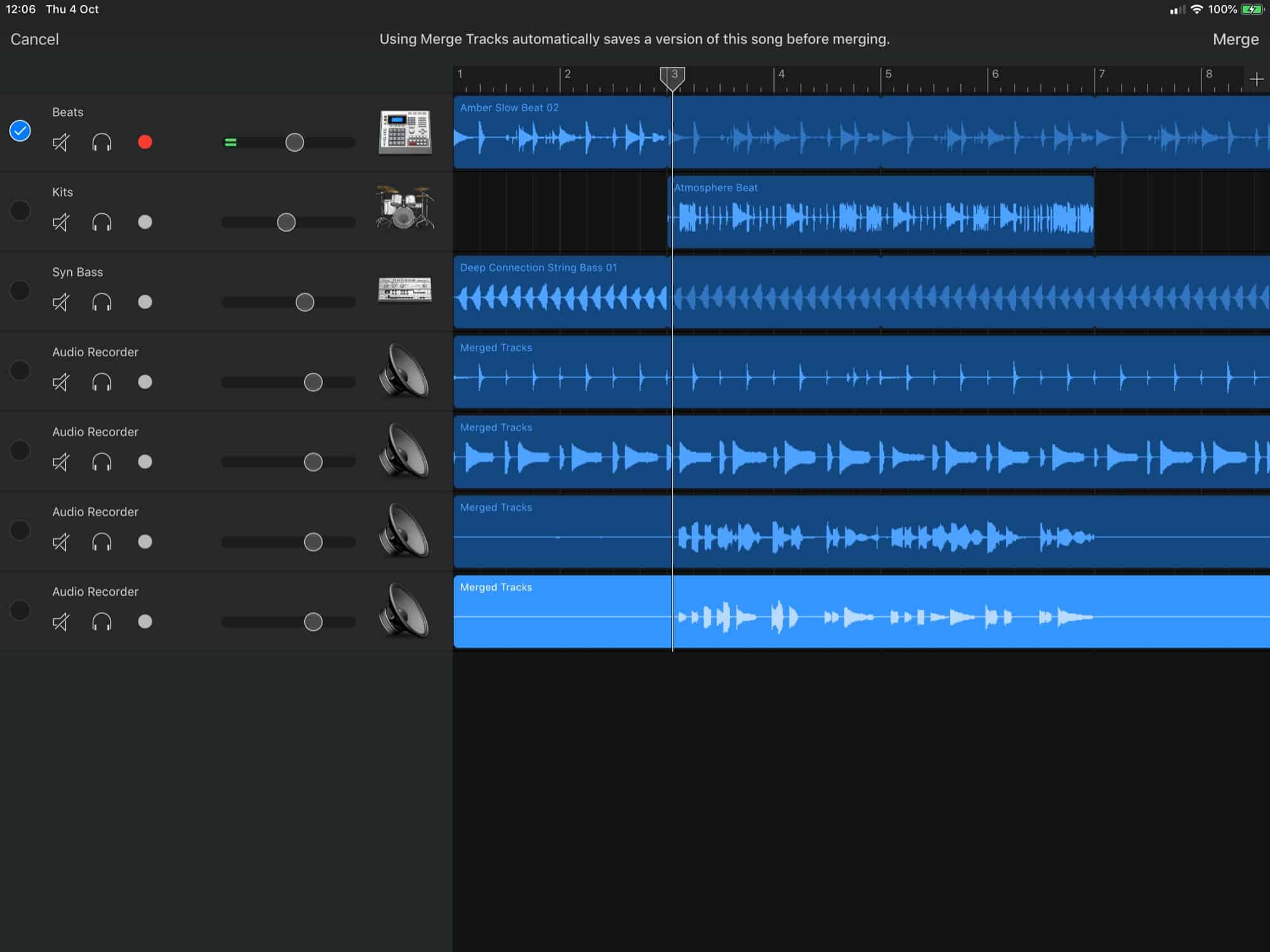
GarageBand is, first and foremost, a music editing software. You can apply each of these techniques to royalty-free music tracks (think Intro and Outro segments) and also create your very own music tracks as well.
You can record real instruments (like a guitar or drum kit) or use one of the virtual instruments that come with GarageBand (like synth, keyboard, or one of the software instruments). Just add a new instrument track for each layer and experiment with creating your very own theme music.
Rename Tracks Garageband Ipad To Pc
Pro Tip - Apple Loops are prerecorded musical phrases or riffs in the Loop Browser that you can use to easily add drum beats, rhythm parts, and other sounds to a project. These loops contain musical patterns that can be repeated over and over, and can be extended to fill any amount of time.
We recommend composing any music tracks in a separate GarageBand project so you can focus on dialing in the perfect tune without it being impacted by the other parts of your podcast episode.
Step 4 - Episode Assembly and Mixing in GarageBand
Once you've edited your recorded content to your liking, you'll need to arrange and mix the tracks into a cohesive episode. There is no uniform way to do this, but it's generally a best practice not to put multiple types of audio on the same track. Music, sound effects, and each voice, for example, should be kept on their own tracks.
Serato Video 1.1 is the biggest news, with a host of new power features, while Serato ITCH 2.2.2 and Serato Scratch Live 2.4.3 get incremental updates plus compatibility with the new features of Serato Video 1.1.The announcements were made simultaneously because upgrading to the latest versions of Serato ITCH or Serato Scratch Live is necessary to use the new video upgrade. Serato scratch live download. Serato’s newsletter announcing the upgrades today.In a slew of announcements, Serato today revealed updates to all of its software (apart from the entry-level program).
Rename Tracks Garageband Ipad Pro
Arranging Your Tracks
One option to get you started is to arrange your audio tracks chronologically, beginning at the top. In this example, we have an intro clip taken from the interview that starts the episode, followed by theme music on a track just below, then intro narration, then the interview itself, and so on. This arrangement affords a level of visual organization, with audio cascading from top left to bottom right.
Another option is to use one track per audio source so that any track-level effect processing you do (EQ, compression, etc.) only has to be set once. In this setup, the intro clip would be on the same track as the interview, since they're from the same source. Intro and outro narration would be on one track, assuming both segments were taken from the same recording. Intro and outro music could potentially be on the same track if you're not using different processing on them. In addition to track-level effects, this approach can minimize the number of tracks you use in your mix and save vertical real estate in your workspace.
Mixing Your Tracks
At its heart, mixing is simply the process of striking a good balance between the levels of your different tracks. You want to avoid extreme differences in volume as your listeners move from intro music to narration to the interview, etc. We recommend using the voice level of your recording as the baseline for setting other levels – music, sound effects, etc.
Rename Tracks Garageband Ipad 2
In GarageBand, each track has a metered volume slider in the track header. Listen to your episode content and make sure the voice levels are triggering a healthy green on the meter. If they're reaching yellow or red, turn them down accordingly. Next, set any intro or outro music to a level that sounds consistent with the voice level – not significantly louder or softer. Do the same with any sound effects, narration, and so on. Balancing the volume of each track in this way will give you what's called a static mix.
Once you've set your static mix (overall volume for each track), you can leverage the power of automation. Add volume automation to music to dip it under your intro narration or to fade the level out smoothly and gradually. If there are any cuts in your audio that cause a pop or click, you can use the GarageBand automation 'crossfade' trick to eliminate them.
Next, you may want to use audio processing plugins like EQ or compression to shape the tone or dynamic range of your material. Don't go overboard – a 'less is more' approach is recommended in most cases. Make sure that any effects processing doesn't add or subtract volume from your static mix – those levels you liked at the outset are your true north. Some plugins include an output control to raise or lower the volume back to its unprocessed level, but you can also use Garageband's Gain plugin, located under the 'Utility' section of the plugin list.
If you're looking for even more mixing and mastering capabilities, consider upgrading to Logic Pro X, Apple's pro-level audio editing software (available in the app store).
Step 5 - Export your podcast
Before you export your final episode, hit the play button and listen to each segment of the episode to look for any mistakes you might have missed during the editing process. When you're pleased with the mix, the next step is to export it as a single audio file to upload to your podcast host for distribution.
In the menu bar, click Share > Export Song to Disk. A dialog will open where you can name your file, choose a destination for it, and select your export format (wav, mp3, etc.) and file quality. Click 'Export,' and GarageBand will export your mixed file to disk.
It's worth noting that mp3s are a preferred format for podcasting because of their compressed file size. Smaller files = quicker downloads and a better listener experience. However, to ensure the best audio quality, you should still export an uncompressed .wav file. Your host and mastering services like Auphonic will automatically transcode your file to mp3 during their process, so if you're unsure of the ins and outs of file formats, it's best to upload at a higher quality and let them handle it.
With your file exported, go for a cup of coffee or a walk to refresh your ears. Come back when you're ready & listen through the episode for quality control. Once you're satisfied, upload to Auphonic or directly to your host for distribution and wait for the fan mail to hit your inbox.